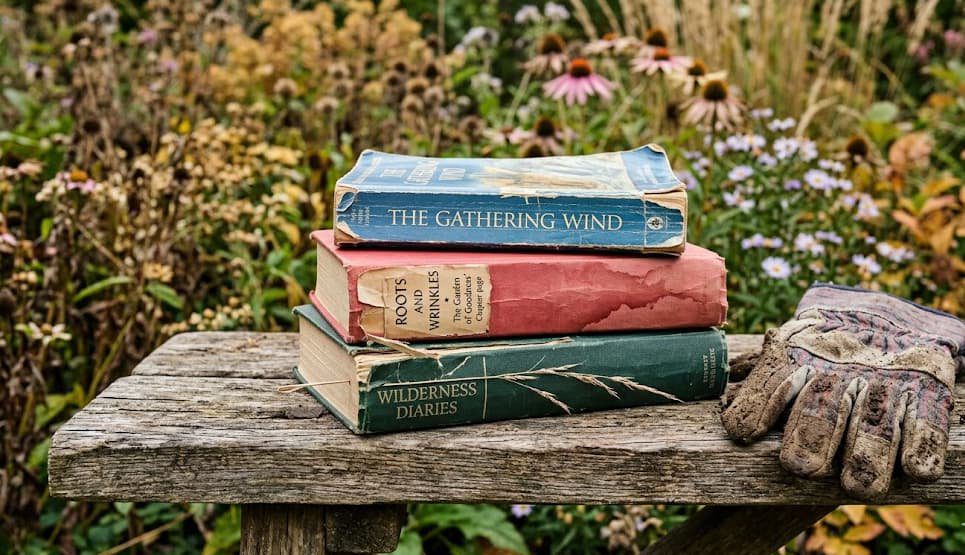
Why Not Gardening Books
I own a shelf of horticulture textbooks. I have consulted them for soil chemistry, plant pathology, and pruning diagrams. They are useful. They are not what I reach for in January when the garden is frozen and I need to remember why I do this work.
The books that made me a better gardener are books about attention, about the physical world, and about what happens in a place over time. They do not contain a single plant list. Every one of them has changed what I notice when I walk outside. That is more valuable than any pruning guide.
The Outermost House — Henry Beston
Beston spent a year in a small cabin on the outer beach of Cape Cod, recording the movement of light, the migrations of birds, the violence and stillness of the Atlantic. He wrote with the precision of a naturalist and the patience of someone who had nowhere else to be. The book was published in 1928, and it reads like a reminder of how to pay attention.
What I took from it as a gardener was his discipline of looking at the same patch of ground every day. He watched the same stretch of beach through every season, every weather, every time of day. That is what a garden asks of you. Not to install plants and move on, but to watch a single bed for years until you understand its patterns. After reading Beston, I started keeping a garden journal not of tasks completed but of what I noticed. That journal has taught me more than any class.
Dirt: The Erosion of Civilizations — David R. Montgomery
Montgomery is a geomorphologist, and his book is a history of soil. Not soil science in the textbook sense, but the story of what happens when civilizations take soil for granted and watch it wash away. It is a quietly furious book, and it changed the way I see every handful of dirt.
Before I read it, I understood soil as a medium. Afterward, I understood it as a living membrane between rock and sky that takes millennia to build and a single generation to destroy. I stopped tilling. I stopped leaving soil bare in winter. I started mulching obsessively. Not because someone told me to, but because I had absorbed the scale of what is lost when topsoil moves. If you garden, you are in a relationship with soil. This book makes that relationship feel as urgent as it actually is.
Seeing Things Whole — John Burroughs
Burroughs was a 19th-century naturalist from the Catskills who wrote essays about birds, weather, and walking in the woods. He had no interest in horticulture as a discipline, but he practiced something I try to bring to my garden every day: the belief that a small piece of ground, observed closely over time, reveals as much as any wilderness.
His essay "The Art of Seeing Things" is the single best argument I have read for gardening as a practice of attention rather than a series of chores. He writes that most people walk through a field and see grass. A few see the different species, the insects moving through them, the light at a particular angle. The difference is not knowledge. It is a willingness to look longer. I read Burroughs in winter and it sends me into spring with my eyes already focused.
What These Books Share
None of these books will tell you how to prune your hydrangea. They will not solve your drainage problem or identify the pest on your squash leaves. What they will do is change what you notice when you kneel in the dirt. Beston teaches patience. Montgomery teaches reverence for what is underfoot. Burroughs teaches the discipline of looking until you actually see.
Every gardener I know goes through a phase of chasing solutions — the right fertilizer, the perfect cultivar, the secret trick. These books are an antidote. They remind me that the garden is not a problem to solve but a place to pay attention for the rest of your life. If you read one this winter, make it Montgomery. If you read two, add Beston. If you read all three, you will walk into your garden next spring a different gardener than the one who left it in November.
Letters
No letters yet — be the first to write.