Why Under the Maple Is So Hard
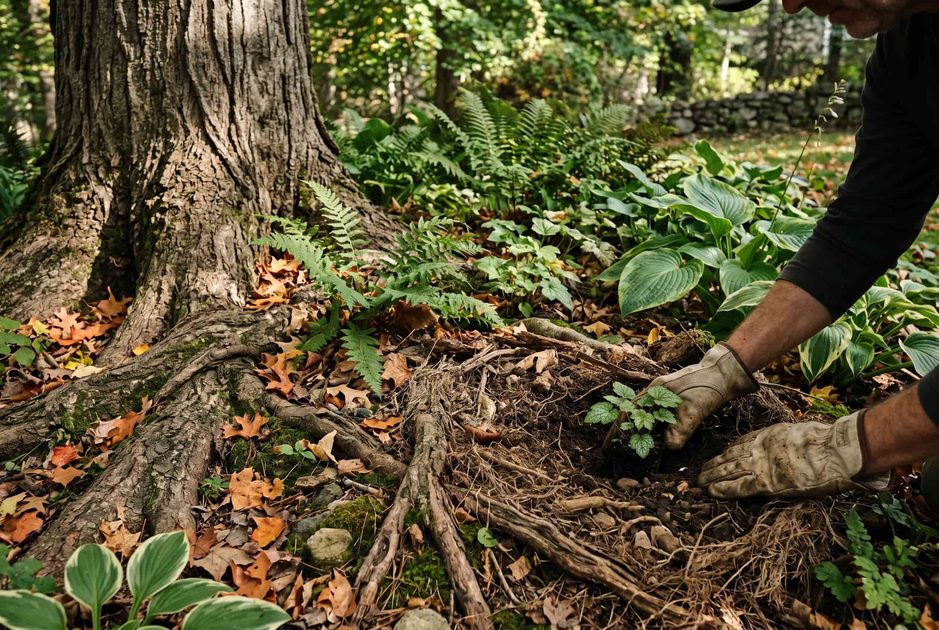
Planting under a mature maple tree is not like planting in any other shady spot. The tree claims everything. Its dense canopy blocks rain before it hits the ground. Its shallow roots form a mat that chokes out anything trying to establish. And those roots pull every drop of moisture and every available nutrient from the soil before a new plant can touch it.
I have a century-old sugar maple in the back corner of my Dorchester yard. For three years after I moved in, the ground beneath it was bare dirt and surface roots. I planted hostas. They shrank each year. I planted astilbe. It crisped by July. I planted a rhododendron that was dead by September. I blamed the plants. The plants were not the problem.
Start With the Soil, Not the Plants
The mistake I made was digging individual holes, filling them with compost, and dropping plants in. In dry shade under a maple, each hole becomes a compost-filled bucket surrounded by a root mat. The tree roots find the compost immediately, fill the hole, and choke the newcomer. Meanwhile, water drains out of the compost into the surrounding dry soil, and the plant ends up worse off than if I had done nothing.
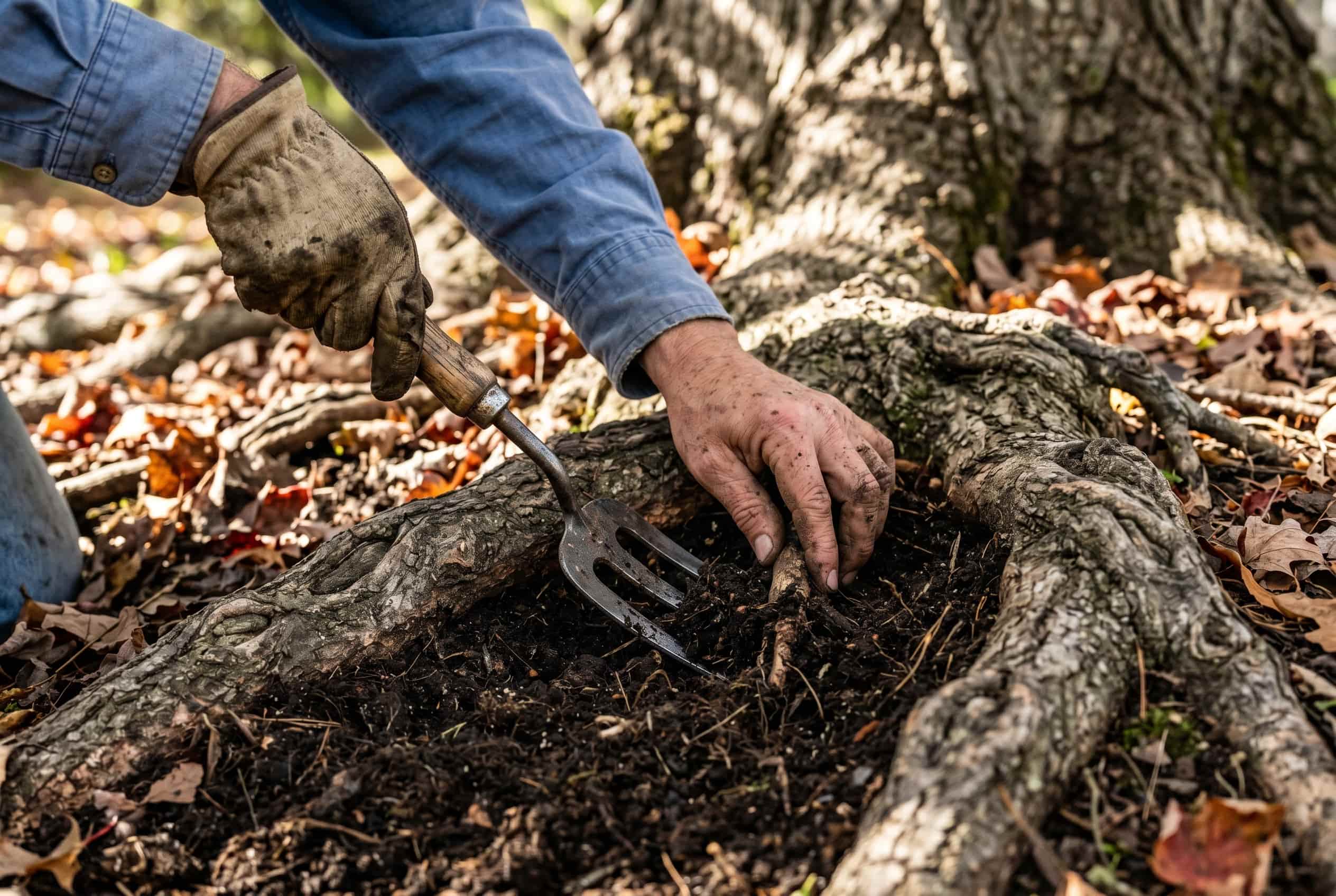
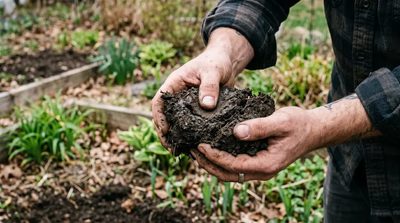
What works is amending the entire planting area at once, before you place a single plant. Remove leaf litter and loosen the top two inches of soil with a hand fork, working carefully between surface roots. Do not cut roots thicker than your thumb. Spread two inches of compost over the entire area and work it in lightly. Then spread another inch and leave it on the surface as mulch. The goal is not a deep, fluffy bed. The goal is a thin, consistent layer of organic matter that mimics what happens on a forest floor.
This approach feeds the soil biology, holds moisture across the entire root zone, and gives new plants a fighting chance without creating compost pockets that the tree will invade. It is slow, quiet work. Do it in spring when the ground is moist but not wet.
How to Plant Between Roots
You will not find open ground. You will find roots. The trick is finding pockets between them where a small plant can establish.
Dig only the hole you need. Slide a trowel between roots rather than chopping through them. If you encounter a root the diameter of your finger, move the planting spot two inches. If the plant's root ball does not fit, do not cram it in. Shave the sides of the root ball gently with a knife to reduce its size, or choose a smaller plant. A quart-sized perennial will establish faster and with less damage than a gallon-sized one.
Water each plant in deeply after planting. Then water once a week through the first full growing season, even if it rains lightly. The canopy intercepts far more rain than you think. I set up a small sprinkler for an hour under mine every Sunday from May through September. In the first year, that water is the only thing keeping new plants alive while their roots find their way into the soil.
Five Plants That Have Survived Under My Maple
I have planted and lost more things under this tree than I want to admit. These five have not only survived. They have spread.
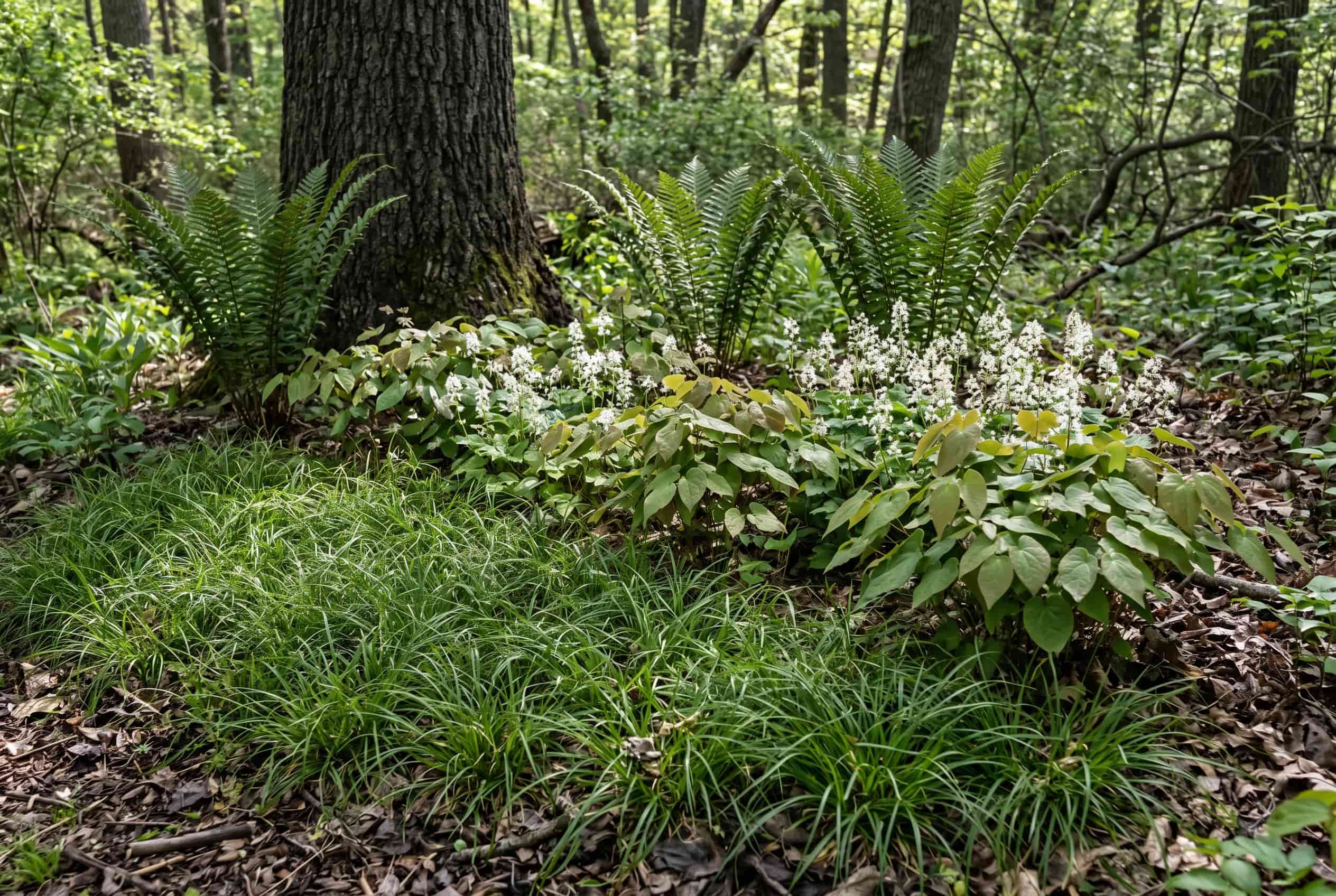
Carex pensylvanica is a native sedge that forms fine-textured, low green tufts. It spreads slowly by rhizomes, weaving between roots. It handles dry shade better than any grass-like plant I have tried. I planted six plugs four years ago. They now cover a four-foot patch and look like they belong there.
Epimedium x versicolor 'Sulphureum' is the plant I recommend when someone has given up on dry shade entirely. Heart-shaped leaves emerge red in spring, turn green, and hold through fall. Tiny yellow flowers appear in April. It spreads by rhizomes and forms a dense groundcover that competes with surface roots. It is expensive per plant, but three will become a drift in four years.
Dryopteris marginalis, the marginal wood fern, is native to New England and built for this. It grows in the cracks of rocky ledges in the wild, so maple roots do not intimidate it. It stays evergreen through winter, adds height and texture, and asks for nothing once established.
Hosta 'Blue Mouse Ears' is the only hosta that has thrived under my maple. It is small, thick-leaved, and tolerates dry shade better than any large-leaf variety. Slugs leave it alone. It stays compact and looks tidy from spring through frost. I planted three as an experiment. All three are still there, slowly expanding.
Tiarella cordifolia, foamflower, is a native groundcover with maple-shaped leaves and white flower spikes in May. It spreads by stolons and fills gaps between roots naturally. It is semi-evergreen in our climate and needs no deadheading. I use it to cover the bare soil between larger plants.
What Fails and What I've Learned
Astilbe fails without constant water. Large hostas shrink year after year as roots steal their moisture. Most ferns that need moist soil will not make it. Rhododendrons and azaleas suffer and die slowly, and I have learned to tell people not to try.
The plants that succeed under a maple succeed because their root systems are shallow, fibrous, and competitive. They do not need deep soil. They do not need consistent moisture. They handle being dry for weeks and do not panic when the tree takes first claim on every drop of rain that reaches the ground.
Give them a thin layer of compost, weekly water for the first year, and a light mulch of shredded leaves each fall. After that, leave them alone. The best thing you can do for a shade garden under a mature tree is to accept that it will never look like a nursery catalog. It will be sparse in places. Some plants will wander. It will look like a forest floor, because that is what it is. That is the look worth pursuing.
Letters
No letters yet — be the first to write.