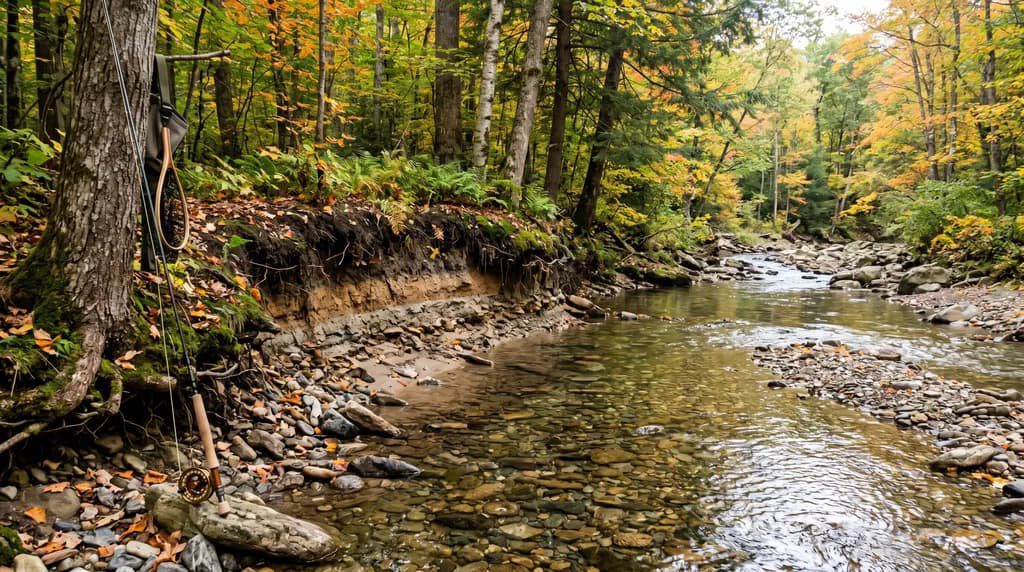
I fish a small stream in central Vermont every September. It runs through a mixed hardwood forest, cold and clear, with pools deep enough to hold native brook trout. I go for the fishing, but I stay for the banks. The stream cuts through glacial till, exposing soil profiles that are normally hidden under grass or pavement. Every year I find myself putting the rod down to look at the dirt.
Last fall, after a heavy rain the night before, the stream was running high and slightly cloudy. The water had undercut a section of bank, and a fresh cross-section of soil stood exposed like a diagram in a textbook. I knelt in the wet gravel and spent twenty minutes looking at it. That bank taught me more about soil structure than I had learned in a classroom.
What the Bank Showed Me
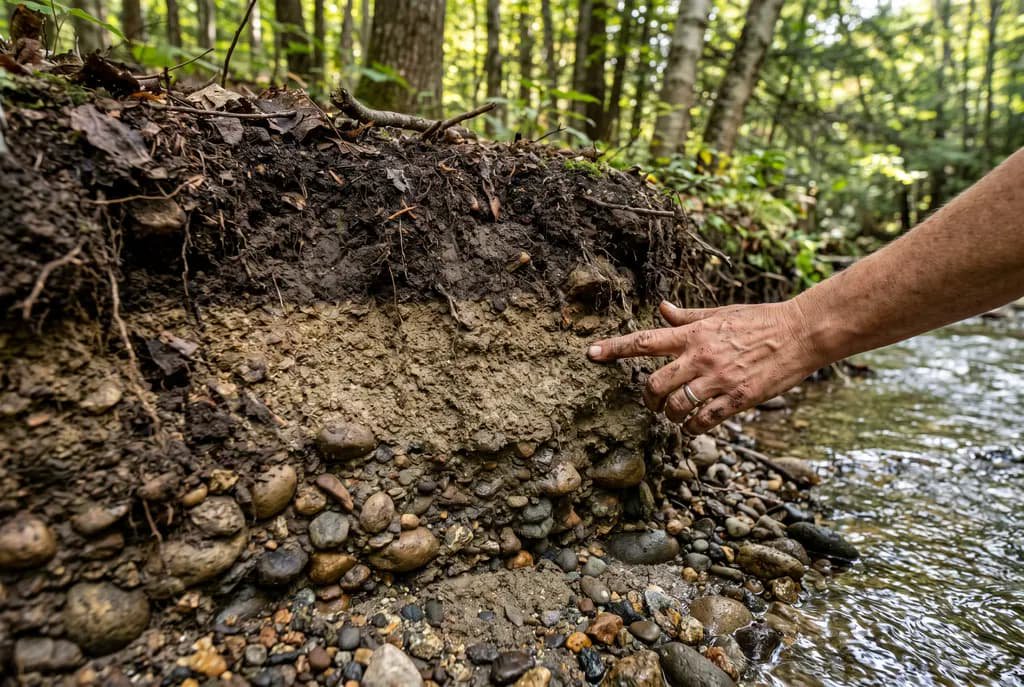
The exposed face was about four feet high. At the very top, a thin band of black, crumbly material — last year's leaves, partially decomposed, mixed with fine roots. That was the organic layer. In a healthy garden, that layer is mulch and compost, constantly broken down by soil life. It prevents erosion, feeds microbes, and holds moisture.
Beneath it lay the true topsoil — about eight inches of dark brown loam. I squeezed a handful. It held together but crumbled when I poked it, the texture of good garden soil. The stream had eroded the finer particles away at the face, but I could see how it would drain well and still hold nutrients.
Then came the transition. Below the topsoil, the color shifted to a lighter brown, then to a greyish-tan. The texture changed too — fewer visible roots, more silt and fine sand. This was the subsoil, lower in organic matter, more compacted. In my own backyard, this is the layer I hit when I dig deeper than a spade's blade. It's the reason drainage slows down and roots struggle if I don't improve the upper layer.
At the very bottom, resting on bedrock, lay a band of rounded stones and coarse sand — glacial outwash from ten thousand years ago. The water moved freely through it. This is the aquifer layer, the deep drainage. It's also the reason raised beds in our region need to connect with the native soil below. If I build a raised bed and line the bottom with landscape fabric, I'm severing the connection to that deep drainage layer. The water sits above the barrier, and roots drown.
I dug a sample from the silt layer with my trowel and dropped it into my palm. It felt like flour when dry, slick when wet. Pure silt. I have this same material in pockets of my backyard, deposited there when the glaciers retreated and left behind sorted layers like this streambank. I used to wonder why some corners of my garden stay waterlogged while others drain fast. Now I know: I'm gardening on top of a streambed that hasn't seen water in millennia, but its layers still dictate what happens to mine.
How Water Sorts the World
The stream sorts particles by size. When the current slows, the heaviest material drops first — gravel, then coarse sand. As the water slows further, fine sand and silt settle. Clay only drops out in still water. This is exactly what happens in a jar test on your windowsill. The stream does it in real time, across gravel bars and back-eddies.
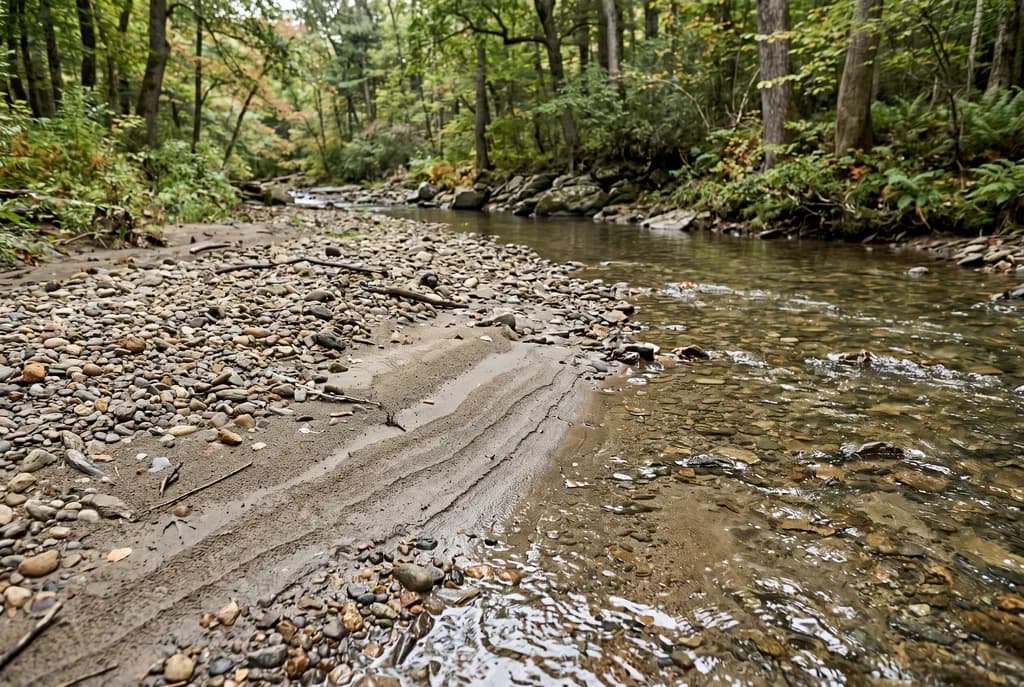
I found a gravel bar where the water had receded after the storm. The surface was arranged in subtle ridges, with coarse sand on the upstream side and fine silt on the downstream. That pattern is exactly what happens in a garden bed when I water too hard with a hose — the force of the water sorts the surface particles, washing away the finest material and leaving coarse sand behind. Over time, that creates a crust that water can't penetrate. I learned to water gently with a breaker nozzle because I saw what a hard stream does to a gravel bar.
What I Took Home
I drove back to Dorchester with my fishing gear and a small bag of silt from that bank. I didn't need it for anything practical. I just wanted to remind myself that soil is not a static thing. It moves, sorts, drains, and compacts according to the same physical rules that govern a mountain stream.
When my clay soil cracks in August, it's because fine particles are contracting as water evaporates — the same way a silt bank pulls away from itself when it dries. When my raised bed drains poorly, it's because I've created a boundary between two soil textures, and water pauses at that boundary just like it pools above a clay lens in a streambank. When my compost sinks and disappears into the soil by spring, it's because organic matter behaves like the leaf litter on that forest floor — always breaking down, always moving downward.
You do not need to visit a Vermont stream to learn these things. A shovel and a hole in your own backyard will teach you plenty. But if you get the chance to stand in a stream and look at a cut bank, do it. The soil under your garden came from somewhere. Water shaped it. Water still shapes it. The more you understand how water and particles interact, the less you will fight your soil and the more you will work with it.
Letters
No letters yet — be the first to write.